The Change Behind the Change: Inside the Journey of Team Balika Volunteers
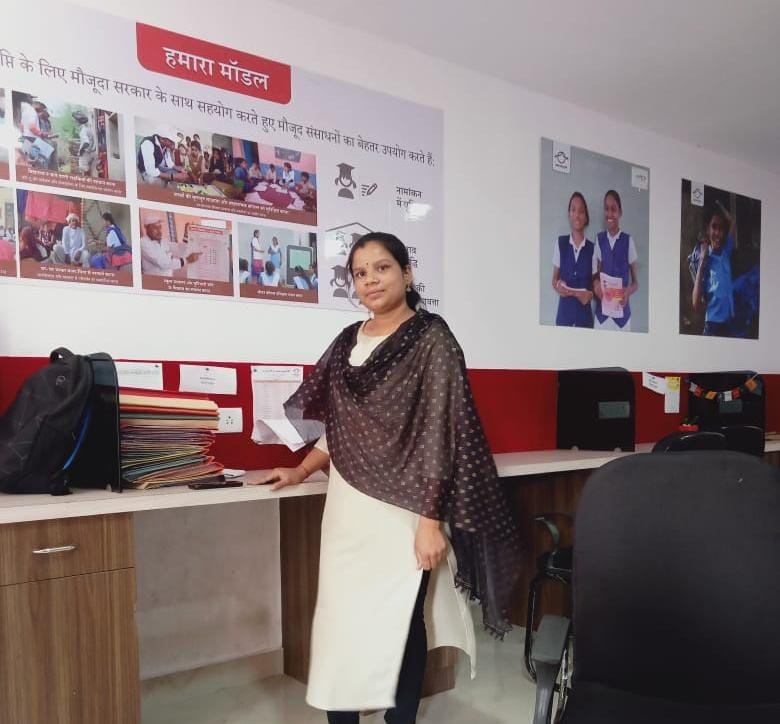
“Earlier, I couldn’t speak in front of everyone. Now I answer fearlessly “
Priti, a Team Balika volunteer from a village in Uttar Pradesh, describes one of the changes she has
seen in herself since she began volunteering with Educate Girls.
Hundreds of kilometres away, in a village in Rajasthan, Team Balika Nagina speaks about something
strikingly similar. She remembers a time when speaking in front of a group felt unfamiliar. Today, she
is comfortable participating in meetings, travelling for training and speaking with families in her
community.
Priti and Nagina are two of several thousand. Since 2007, more than 55,000 community volunteers,
known as Team Balika, have dedicated their time to promote girls’ education with Educate Girls.
Team Balika volunteers emerge from the communities they serve, guided by the belief of ‘My village,
my problem, I am the solution’. They help identify out-of-school girls, encourage families to enrol
their daughters in schools, and act as advocates for education within communities that often face
deep-rooted social and economic barriers. Most Team Balika volunteers have grown up witnessing
the very challenges they now work to address.
Conversations with current and former Team Balika volunteers raised a question: “What Impact
Might Volunteering Have On The Volunteers Themselves?”
The Team Balika describe being pushed beyond their comfort zones – speaking up in village
meetings, interacting with Panchayati Raj Institutions, or simply knocking on doors and starting
conversations with families. Visiting the villages with these volunteers offers a glimpse of just how
challenging it is to take that first step outside a familiar world.
For Nagina, the barriers were not unfamiliar. She had hoped to pursue a teaching program but could
not afford the fees. Before joining Team Balika, she had little experience navigating spaces beyond
her immediate surroundings.
Volunteering began to change that. The role required her to travel, attend trainings organised by
Educate Girls, and speak with parents about their daughters’ education. Gradually, the unfamiliar
became familiar.
For Nagina, the change was not simply about becoming better as a volunteer but about discovering a
confidence that she had not previously experienced. For many, joining Team Balika was their first
opportunity to be heard, trusted, or recognised beyond the household. This gain in confidence is
only part of the story. Volunteers also spoke about something equally important: recognition.
Sarita had only just passed her Grade 12 when she joined as a volunteer, on the insistence of her
mother. Years later, a former teacher told the school staff: “The girl we once taught is sitting before
us on a chair today — it feels good to see.”
For Sarita, that recognition was a powerful validation of her efforts. For many volunteers, it signalled
that their voice had weight. They were no longer only participating in community life but were
helping shape it. Parents pointed to their village Team Balika when encouraging their own daughters
to continue school. Younger girls watched them travel independently or speak confidently in public.
Other young people grew curious about volunteering too — including boys, who saw adult men
standing up for girls’ rights.
None of this came easily. Volunteers spoke about the difficulty of convincing parents who
questioned the value of education. Others were questioned for attending meetings and trainings
without being paid. For young women like Vandana, even moving through the community for this
work could invite comments and scrutiny. Over time, she learned to let those voices recede into the
background and focus on the work itself.
Many, like her, have continued despite these challenges. Why?
Part of the answer lies in their sense of purpose. As Vandana put it: “If a girl fights for another girl,
then naturally, society will change.” The work mattered to them because the issue mattered to
them. But purpose alone doesn’t sustain long-term unpaid work. Volunteers also spoke about the
relationships they built, the skills they gained, and the sense of identity they developed. As Nagina
reflects: “…Earlier we worked only at the village level, now we get the chance to go to the office…
We had never left our village before; now we’re experiencing different trainings and new places.”
The journeys of Team Balika volunteers have taken many different directions. Anamika Joshi’
schooling was interrupted after Grade 8 because her family could not afford to continue it; she
eventually resumed her education with support from her sister. Team Balika became one of her first
opportunities to step outside the boundaries that had shaped her life. Today, she works as a
Volunteer Management Associate at Educate Girls.
Another volunteer with the same first name, Anamika Singh’s journey, took a different route. The
eldest of four sisters from a village in Madhya Pradesh, she joined Team Balika while in Grade 12,
curious about how an organisation worked. This path eventually led to the Gandhi Fellowship in
Bihar and to her current role as a Program Coordinator at Educate Girls.
Some of them have continued in community development, while others have moved into
fellowships, further education or professional roles. What connects their stories is not where they
went next, but what volunteering made possible along the way: greater confidence, new skills, wider
exposure and a stronger sense of their own voice and identity.
The strength of community volunteer models like Team Balika lies not only in the awareness they
create or the girls they help enrol. It also lies in the people they help shape along the way. Perhaps
this is the change behind the change: volunteers step forward to support girls’ education, and in
doing so, many begin to see themselves differently too. That change then travels back into the
community through the confidence, voice and example they carry with them.
Educate Girls
Posted on September 9, 2026
Interested in contributing towards educating girls?
Quick Links
Resources & More
Keep helping. Stay Updated.


Child Protection Policy | Privacy Policy | Terms of Use | Employee Login | IT Assets
Educate Girls is a project of Foundation To Educate Girls Globally (FEGG) | FEGG is registered in India under Section 8 of the Indian Companies Act, 2013.
© 2026 All rights reserved. Educate Girls.
